Chapter 2 · Installing and Wiring
Wiring the Lights
Good lighting can still be let down by poor wiring. The way the lights are cabled and powered decides how much work the installation takes, how much space the cabinet needs, and whether the lights stay on in a power cut.
LOXONE Tree lighting makes wiring the easy part, as long as you follow a few rules. Most problems on site come from breaking one of them.
By the end of this lesson you will be able to:
- Wire LOXONE Tree lights with the correct cable and power supply
- Explain why the lights get their own supply, and what makes that work
- Set up an RGBW 24V Dimmer for an LED strip, and feed a long strip so it stays evenly bright
The situation
The lights for an apartment are chosen and marked on the plan. There are LED Spots in most rooms, an LED Ceiling Light in each bedroom, and a long LED strip under the kitchen units. The cabinet with the Miniserver sits by the entrance.
Now the cable has to run from the cabinet to every light, the supply has to be planned, and the customer has one more request. When the strip is installed, they want it to look the same brightness from one end to the other.
Tree wiring, and why it is simple
LOXONE Tree lights run on 24 V DC and receive their control over the Tree bus. The dimmer is built into each light, so there is no row of dimmers in the cabinet and no thick cable from the cabinet to every fitting.
A Tree light is wired with a five conductor cable that carries the Tree data pair and the 24 V DC power. The same approach covers the LED Spot RGBW Tree, the LED Ceiling Light RGBW Tree and the RGBW 24V Compact Dimmer Tree.
Tree wiring can follow almost any topology. The cable follows the building, instead of the building having to make room for the cable.
Give the lights their own power supply
This is the rule partners most often get wrong. Power the lights from their own 24 V supply, separate from the supply that runs the system, meaning the Miniserver and the Extensions.
Keeping them apart means a heavy lighting load can never disturb the stable supply the system needs. There is one condition that makes this work.
A supply that keeps the lights on
The most suitable way to power a LOXONE project is the Power Supply and Backup. This 24 V supply is divided into seven separately protected and metered circuits, and a backup battery can be connected to it.
In a power cut, the essential lights keep working. Because they dim, they can run at a lower level, which makes the battery last much longer. A 230 V lighting circuit cannot offer this, and it is a real selling point for a customer who wants their home to keep working during an outage.
Wiring an RGBW 24V Dimmer for strips
When you drive an LED strip instead of a LOXONE fitting, the RGBW 24V Dimmer sits between the Tree and the strip. It takes its data over Tree and its power from the 24 V supply. It has four channels, each up to 50 W at 24 V.
How you wire the output depends on the configuration you choose for those four channels. Settle that before anyone pulls a cable.
In full RGBW, one dimmer drives up to 200 W at 24 V, or 100 W at 12 V. In every other configuration, each channel is limited to 50 W at 24 V, so check the total load of each strip against that limit.
The compact version of the dimmer fits into furniture or a ceiling void. That suits a strip under kitchen units, where you do not want the dimmer back in the cabinet.
Keeping a long strip evenly bright
Long LED strips have a problem the customer can see. The far end looks dimmer than the near end. This is voltage drop along the strip. A high voltage drop also overheats the first section of the strip and shortens its life.
How you feed the power decides whether this happens.
Power from one end. The simplest wiring, but the brightness visibly falls along the strip. Not suitable for long runs.
Power from the far end. The voltage drop is still there, but the change in brightness is more gradual, so it is less obvious.
Power from both ends. The brightness stays almost even, the strip does not overheat, and its life is protected. This is the best solution for long strips.
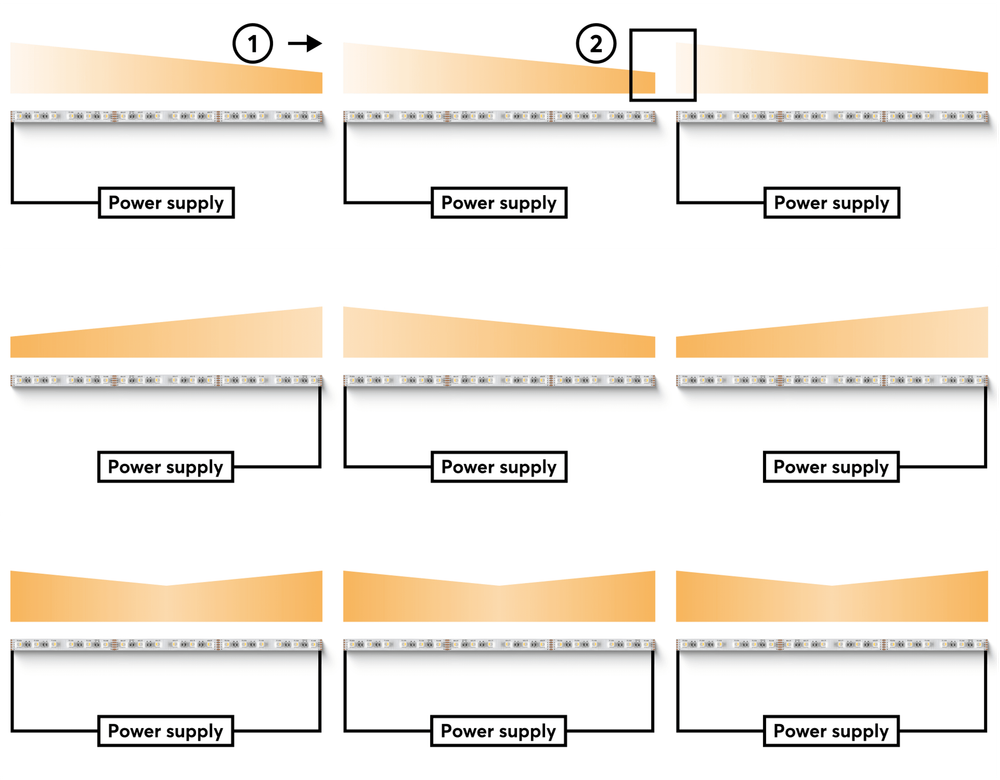
The brightness visibly falls along the strip
Change in brightness is more gradual
The brightness stays almost even